Sneezing is like wet Tourette's.
---Sarah Silverman
---Sarah Silverman
Evolving Robots Learn To Prey On Each Other
The system uses a high-powered laser diode -- a device that converts electricity into light -- as the optical transmitter and an avalanche photo diode -- a device that converts light to electricity -- as the receiver. The light bounces off the walls and is picked up by the receiver.
Got a decision to make? Get some sugar in your system: study
January 30, 2010 -->If you're about to try to negotiate a pay rise, it might be a good idea to have a sugary drink beforehand, according to a study published this week in Psychological Science.
Researchers at the University of South Dakota asked 65 students to answer a series of questions in which they had to choose between getting a smaller sum of money "tomorrow" or a larger sum in the future.
The study participants responded to half the questions on an empty stomach and the other half after consuming a caffeine-free soda sweetened either with sugar or the artificial sweetener aspartame.
Blood glucose levels were measured at the start of the experiment and after the volunteers drank the soda.
"Within 10 minutes of drinking a sugary soda, participants' interest in a larger, future reward was higher," Xiao-Tian Wang, one of the psychological scientists who led the study, told AFP.
"It's like when you eat: if your blood sugar's high, you can wait longer to eat," Wang said.
"We did the study to see if the blood glucose level not only regulates eating behavior but also decision-making. In other words, can you wait longer to get a bigger reward when your blood glucose levels are higher?
"We found that, yes, you can," said Wang, who conducted the study with fellow psychological scientist Robert Dvorak.
Not only did having a higher blood sugar level make study participants less likely to act impulsively, but taking a diet drink made people more likely to act on impulse and take the immediate, smaller reward, Wang said.
"Giving someone a diet drink tells the body that there's an 'energy crisis' because you're giving it something that tastes good but it has no calories.
"Your body realizes that and tries to grab everything available right now. So diet soft drinks lead to increased impulsivity," he told AFP.
(c) 2010 AFP
Lower Blood Sugar NOW - 100% Proven, No Side Effects 100% Natural Supplement - www.HerbalHealthCareOnline.com
Chinese Drywall Victims - Get The Legal Help You Need Today. Instant Case Review. 800-LAW-INFO - defective-drywall-lawsuit.com
Blood Sugar Control - High Blood Sugar can be controlled naturally. Here's how. - www.AlohaMedicinals.com
-->Please register or sign in to add a comment. Registration is free, and takes less than a minute. Read more
Forgot your password? Click here to reset it
Notify me via email of follow-up comments posted here sign in first
| TOP STORY By Michael Lasky The long wait for 64-bit PC software continues Big-name apps remain MIA from 64-bit list A 64-bit IE, but minus 64-bit ActiveX controls WACKY WEB WEEK By Stephanie Small Pac-Man has now invaded your living space Subscribe: http://windowssecrets.com/info/ |
BIGGEST FULL MOON OF THE YEAR: If you think tonight's Moon looks unusually big, you're right. It's the biggest full Moon of 2010. Astronomers call it a "perigee Moon," some 14% wider and 30% brighter than lesser full Moons of the year.

Image credit and copyright: Anthony Ayiomamitis: details.
Johannes Kepler explained the phenomenon 400 years ago. The Moon's orbit around Earth is not a circle but an ellipse, with one side 50,000 km closer to Earth than the other. Astronomers call the point of closest approach "perigee," and that is where the Moon will be Friday night through Saturday morning: diagram.
A good time to look is around sunset when the Moon is near the eastern horizon. At that time, illusion mixes with reality to produce a truly stunning view. For reasons not fully understood by psychologists, low-hanging Moons look unnaturally large when they beam through foreground objects such as buildings and trees. Why not let the "Moon illusion" amplify a full Moon that's extra-big to begin with? The swollen orb rising in the east may seem close enough to touch.
And what's that bright orange star right beside the Moon? Read on...
IT'S MARS! In a coincidence of celestial proportions, the Moon and Mars are having close encounters with Earth at the same time. Moreover, the two will spend Friday night gliding across the sky side-by-side. It's a must-see event: sky map.
Full text: http://spaceweather.com/ (It's a bookmark-worth site overall, too.)

Hmmm. The shape reminds me of lightning "sprites" usually associated with large thunderstorms.
http://www.google.com/search?q=lightning+sprite
I wonder if the electric charge of an aurora might be sufficient to generate similar phenomena.
This is the title of a typical incendiary blog post
Posted by Chris Clarke on January 24, 2010This sentence contains a provocative statement that attracts the readers’ attention, but really only has very little to do with the topic of the blog post. This sentence claims to follow logically from the first sentence, though the connection is actually rather tenuous. This sentence claims that very few people are willing to admit the obvious inference of the last two sentences, with an implication that the reader is not one of those very few people. This sentence expresses the unwillingness of the writer to be silenced despite going against the popular wisdom. This sentence is a sort of drum roll, preparing the reader for the shocking truth to be contained in the next sentence.
This sentence contains the thesis of the blog post, a trite and obvious statement cast as a dazzling and controversial insight.
This sentence claims that there are many people who do not agree with the thesis of the blog post as expressed in the previous sentence. This sentence speculates as to the mental and ethical character of the people mentioned in the previous sentence. This sentence contains a link to the most egregiously ill-argued, intemperate, hateful and ridiculous example of such people the author could find. This sentence is a three-word refutation of the post linked in the previous sentence, the first of which three words is “Um.” This sentence implies that the linked post is in fact typical of those who disagree with the thesis of the blog post. This sentence contains expressions of outrage and disbelief largely expressed in Internet acronyms. This sentence contains a link to an Internet video featuring a cat playing a piano.
Funny post (there's more) and the comments are good, too. Click the via.

The article (click via) is actually about wake effects and turbine inefficiencies--- but what a gorgeous photo!
SILVER SPRING, MD—Frustrated by continued demands from viewers for more awesome and extreme programming, Science Channel president Clark Bunting told reporters Tuesday that his cable network was "completely incapable" of watering down science any further than it already had.
"Look, we've tried, we really have, but it's simply not possible to set the bar any lower," said a visibly exhausted Bunting, adding that he "could not in good conscience" make science any more mindless or insultingly juvenile. "We already have a show called Really Big Things, which is just ridiculous if you think about it, and one called Heavy Metal Taskforce, which I guess deals with science on some distant level, though I don't know what it is. Plus, there's Punkin Chunkin."
"Punkin Chunkin, for Christ's sake," added Bunting, referring to the popular program in which contestants launch oversized pumpkins into the air using catapults. "What more do you people want?"
Along with Bunting's remarks, the Science Channel issued a statement claiming that it currently airs more than 150 programming hours that are tangentially, and often laughably, related to science, and that staff members are unable to bring themselves to make those hours even more asinine.
Debbie Myers, general manager of the Science Channel, said the cable station has maintained a balance of 5 percent science content and 95 percent mind-numbing drivel over the past few years, and that this was as far as they were willing to go.
 "28 days later, the musical" was just one of the entries in a caption contest at
Australian researchers have measured the amount of entropy that exists now in the Universe. They found that the Universe has much less energy available than had been previously measured. Are they right? Is the Universe aging faster?

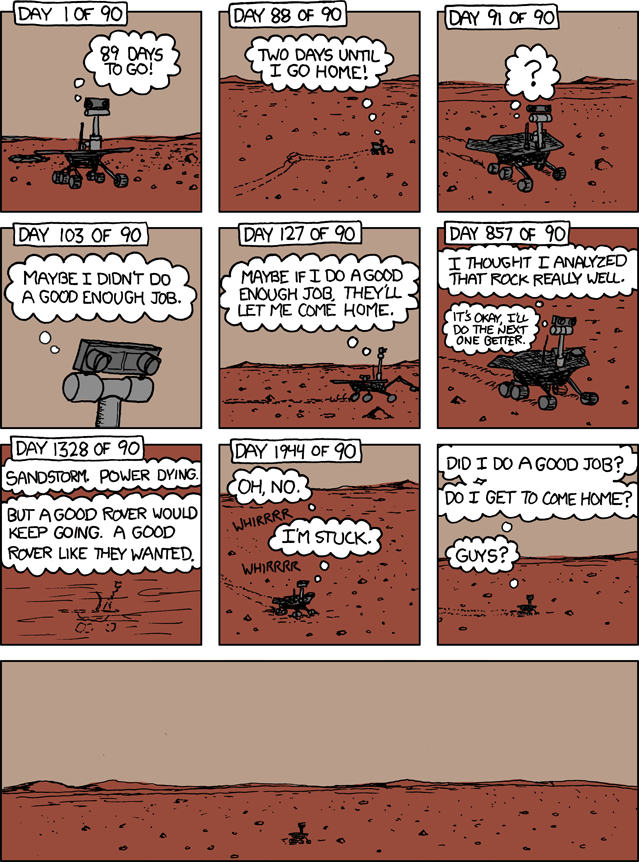
NASA is giving up on trying to move the stuck rover. Now, they'll figure out how to use it best, in place.

Brane theory --- an alternative explanation for the origin of our universe --- is gaining traction. Click the VIA.
TENTACLED monsters, pale skinny humanoids, shimmery beings of pure energy... When it comes to the question of what alien life forms might look like, we are free to let our imagination roam. The science-in-waiting of extraterrestrial anatomy has yet to acquire its first piece of data, so nobody knows what features we will behold if and when humans and aliens come face-to-face. Or face to squirmy something.
Despite this lack of hard evidence, a blend of astronomy and earthly biology offers some clues to what is out there. A few bold scientists are even willing to make an educated guess at the nature of aliens that might exist on faraway worlds.
What these extraterrestrials will be like depends on where and how we expect to meet them. Barring the appearance of flying saucers, there are two broad possibilities: either we have a close encounter with our neighbours by visiting the planets and moons next door; or we make an interstellar phone call to creatures inhabiting much more distant planets that circle alien suns. These two options have different implications for the shape of what we find living there.
What extraterrestrials will look like depends on where and how we meet them.
If first contact turns out to be within our solar system, then at least we have some prior knowledge about the available habitats. Several spots might be suitable for Earth-like life based on carbon biochemistry and using water as a solvent. The subsoil of Mars may be warm enough to host microbes akin to Earth's bacteria, for example, and there could be larger beasts swimming in the watery oceans of some outer moons of the solar system - especially Jupiter's moon Europa. There's every chance that a deep aquatic ocean lies beneath Europa's ice, stretching right down to the moon's rock core, where volcanic vents pump out hot, nutrient-rich water.
Astrobiologist Dirk Schulze-Makuch of Washington State University in Pullman calculates that the energy supplied by these vents could feed a large population of microbes, which in turn could support a pyramid of predators. Europa's top predator, the equivalent of our great white shark, would be a fearsome creature with a mass of - wait for it - about 1 gram. "Europa could support a shrimp-sized organism," he says. There would not be enough prey to feed a viable population of predators bigger than that.
Shrimp-sized doesn't have to mean shrimp-shaped, of course. "It is kind of difficult to say anything about how it would look," says Schulze-Makuch. Even on Earth animals have evolved an astonishing diversity of shapes and body plans, but Schulze-Makuch is nevertheless prepared to speculate. "I would make a guess at something worm-like," he says. "That is a pretty successful kind of organism on Earth."
While the hypothetical ice worm of Europa would be swimming about in boring old water, a few astrobiologists are pushing the boat out and pondering the possibility of life that is not water-based. Most places in the solar system are too hot or too cold for liquid water to exist, but there are several other liquids that might host some kind of biochemistry, says Steven Benner of the Foundation for Applied Molecular Evolution in Gainesville, Florida.
The clouds of Venus hold droplets of sulphuric acid, and billions of years ago there may have been pools of the stuff on the planet's surface. Though pretty destructive to bags of water like ourselves, it could be a refreshing draught for beings with the right biochemistry. These acid-dwellers would have to be formed of chemically resistant materials. "Multicellular Venusians living in liquid sulphuric acid could have veins made of glass," Benner suggests, conjuring up visions of delicate, transparent glassware creatures, rolling carefully over the Venusian rocks. But glass is not the only option: more mechanically robust materials would also fit the bill. "There are flexible polymers that are acid-stable, such as Teflon, polyethylene and silicone," Benner points out.
Elsewhere in our solar system, surface lakes and seas exist to this day - though not watery ones. On Saturn's moon Titan, they are formed from a chilled hydrocarbon cocktail of ethane and methane, and Schulze-Makuch speculates about what forms of life they might harbour. "Things might be bigger," is his unexpected conclusion. "Water has a high surface tension, which constrains the volume of single cells. That's why bacteria on Earth are so small." The surface tension in a methane-ethane blend is much lower, so single cells could be enormous, a possibility that Schulze-Makuch has explored in his novel Voids of Eternity. "I have boulder-sized microbes moving over the surface and guzzling up hydrocarbons," he says. "That is science fiction of course, but there may be something in it."
In our eyes, the Titanians might seem pretty laid back. At around 93 kelvin, Titan's seas are very cold and that makes chemical reactions super slow. "Things could be very slow-moving and slow-growing," says Schulze-Makuch. "The lifetime of such an organism may be 10,000 years, or perhaps as much as a million."
"Scientific American has a story on researchers from the University of Utah who have calculated that 1.2 million years ago, at a time when our ancestors Homo erectus, H. ergaster, and archaic H. sapiens were spreading through Africa, Europe, and Asia, there were probably only only about 18,500 individuals capable of breeding in all these species together (PNAS paper here). Pre-humans were an endangered species with a smaller population than today's gorillas and chimpanzees. Researchers scanned two completely sequenced modern human genomes for a type of mobile element called Alu sequences, then compared the nucleotides in these old regions with the overall diversity in the two genomes to estimate differences in effective population size, and thus genetic diversity between modern and early humans. Human geneticist Lynn Jorde says that the diminished genetic diversity one million years ago suggests human ancestors experienced a catastrophic event at that time as devastating as the Toba super-volcano in Indonesia that triggered a nuclear winter and is thought to have nearly annihilated humans 70,000 years ago."

The picture is of the current record freefall, done in 1960. (Yes, the jumper is wearing a space suit.) This new jump will be higher, and faster.

Full story in the VIA, but this is worth highlighting: "The decade's warmth may also explain why many people didn't view 2009 as unusually hot—in essence, record temperatures are the new normal. Another factor is that the high global mean temperature was driven by the Southern Hemisphere, where it was the warmest year ever seen in NASA's records. For those with a US-centric view of global temperatures, NASA helpfully points out that the contiguous 48 states only account for about 1.5 percent of the world's surface."

"Holiday Inn, operator of over 4,000 hotels worldwide, will begin to offer a free five-minute 'human bed warming service' at it's London Kensington hotel throughout next week. If requested, a willing member of hotel staff will jump in your bed, dressed head to foot in an all-in-one sleeper suit, until your nightly chamber warms up."
Hmmm. Las Vegas hotels have had the same service for years, minus the robes.
| TOP STORY By Yardena Arar Patch arrives for IE hole targeted by Chinese Microsoft downplays the threat, releases a patch Find the right mix of preventive measures The best defense: Keep all your apps updated WACKY WEB WEEK By Stephanie Small This vending machine gives and gives and gives |
Something awfully curious is happening 250 million miles away in the asteroid belt.
Astronomers think they may be witnessing a never-before-seen collision between two asteroids.
The puzzle centers on a newly discovered object that superficially looks like a comet but lives among the asteroids.
The strange object was discovered on January 6 by the Lincoln Near-Earth Asteroid Research (LINEAR) sky survey. The object appears to be in an orbit inside the main asteroid belt -- not a place where comets usually dwell.
The distinction? Comets swoop along elliptical orbits close in to the sun and grow long gaseous and dusty tails as ices sublimate off their solid nucleus and release dust. But asteroids are mostly in more circular orbits and are not normally expected to be as volatile as comets.
In the comments below veteran comet observer Jim Scotti correctly points out that several other weird comet/asteroid hybrids have been reported over the years.
But there is high excitement this time because astronomers following the object are reasonably convinced that for the first time ever they have a ringside seat to watching an actual hypervelocity collision between two previously unseen asteroids. The asteroid belt is littered with debris from ancient shattering collisions, but astronomers have never before seen a head-on smashup in the works.
In the previous cases an asteroid containing ices may have experienced a short-lived outburst. Or, a fragile icy and stony nucleus simply came unglued and the remnants are being scattered by the pressure of the solar wind.
(Perhaps extraterrestrials are playing a real version of the popular 1980's arcade game "Asteroids.")
No doubt there will be many more observations of this evolving phenomenon in the near future, so stay tuned.
Photo Credit: Spacewatch/U of Arizona


...and then the teacher returned the favor. Yikes!

Some strange, overheard statements and conversations. Check the other links, too: Overheard at the office, at the beach, etc.